My opinions:
At least, that is what we should be using technology for. Time and time again I come across devices or software that completely fail in this regard, either by poor design, or even intentionally. Devices these days seem to be designed to market to people, to limit what you can do with a device because some big company wants it that way, or just hacked together.
YouTube
YouTube is dead. It's burried in advertising now.
Comcast
Comcast is Evil. I STILL miss TechTV. They murdered it. There is nothing
on anymore. The cable bill kept going up and up and up and up and up! Finally
I canceled the stupid thing. Think I'll go read a book instead.
OTA TV
Canceling cable, I switched to watching only Over The Air television.
Over all I am very happy with it. All of the stations come in crystal clear,
many have sub channels, and they all have program guide descriptions. And
it's free!
Data DVD-R
Recordable DVD-R and DVD-DL media is extremely useful. The problem
with magnetic media backups is that only one erroneous write makes the
entire backup unusable. "Cloud" or, more properly, third party file hosting,
sites are not real solutions if you don't like putting your data at the
mercy of some third party entity. Bits on CD/DVD media can not change,
and they are all under my own control.
Wide screen AKA "short screen"
Where did the sudden perceived need for "wide screen" come from? I
always expected that movie-theater like wide screen formats would die out
as TVs and TV movies became more popular. But both TVs and Monitors are
now all "Wide screen" these days. This means TVs regularly show old video
that is cropped on the edges - or worse yet, stretched. For a typical computer
desktop a wide screen works just fine, but the wide screen aspect ratio
causes all kinds of problems with older applications and games. For example,
a drawing application running at 1024*768 can no longer properly draw a
circle as the image is always stretched to fill 1440*900 - which results
in an oval. Also newer LCD monitors no longer operate with oddball lower
resolutions that many old multsync CRTs were capable of. In other words,
no more running MAME games or MESS machines at native resolutions.
Smart Phones
"Smart" phones are for dumb people. Specifically, consumertards.
I don't exactly hate smart phones, but personally, I can hardly think of
a single use that would make it worth my while to own a "smart phone".
The primary things "normal" people use smart phones for are so simplistic.
Posting on social media wherever you are? Well, I don't post on social
media at all! Using it to keep track of shopping lists? Are you kidding
me? Do you have to do shopping for an army or something? A simple, cheap,
pencil and paper works perfectly for me. The only thing I can even think
of that could be useful to me is pulling up maps - but I always plan out
where I am going in advance. If I even have to look down once while I am
driving, then I have done something wrong. Not worth my money. There are
so few real needs, that consumertards feel compelled to find artificial
needs, such a covid 19 test that, literally
for no reason, REQUIRES a smart phone. Don't even get me started on
Lyft/Uber.
I don't doubt some people have genuine useful needs for them. If everyone saw cell phones/mobile phones as a nessicary burden, then I woudn't even care so much. But after all these years, people are still just sooooo in love with their damn smart phones. I can't even critize smart phones without people getting massivly insulted, like I just kicked their dog or something. If you really love your cell phones that much, there is something seriously wrong with you.
Texting
"Texting"?! Face it, texting is for teenage girls. I'm serious. I will
NOT be interrupted when I am busy doing something. If you want to communicate
with me, then send me an e-mail and I will get to it in a few hours. If
it is really important, then give me a voice call. Otherwise, fuck you.
Aside from idiots that think they need constant "alerts" as if they were a fancy doctor with a pager or something, there is the technical issue that texting, AKA SMS is tied to cell phones. I can use hundreds of different e-mail services, I can set up my own e-mail server, I could read and send e-mail on an IBM PCJr or any other crazy kind of device if I wanted to, there are piles of software to manage, route, or process e-mail. But texting? No you have to have a cell phone. Derrr. I am aware there are some exceptions, but it is still tied to the cell phone network.
Again, I wouldn't care so much if people weren't just so crazy in love with it. I have run in to people who get totally confused when they find out they can't "text" me. And then they somehow get insulted because I am different. (Yet if the problem were I only spoke spanish, then they would somehow be fine with that.). Even worse than that, I have run in to some web sites, that stupidly assume EVERYONE has a smart phone that can receive "texts". Uh, since it a web site, and I am accessing the web, I also have e-mail. I even have a regular telephone number. But somehow, they expect it MUST be ONLY a damn cell phone. That is just stupid.
Games
Thanks to the invasive copy prevention mechanisms game produces put
in most games these days, I wouldn't touch a boxed game with a 10 foot
pole! I'm sorry, my computer does not belong to YOU. I'm not keeping a
CD in the drive, I'm not attaching some stupid dongle, and I'm not keeping
an internet connection open so you can validate. I was actually OK with
doc checks, but people don't even know what a manual is these days. Modern
consoles? I duno, hardware is too locked down for my tastes. Flashy graphics
and realistic 3d worlds? Who needs it? Long live the 1993 classic DOOM!
The "Crash Key" (Windows Logo key)

I call it the "Crash Key" because on older versions of Windows, pressing
it while a DOS program was running could cause Windows to crash.
It makes me sick that PC keyboard manufacturers would put a key on all of their keyboards that contains a copyrighted, trademarked symbol. Up until about the mid 1990s standard IBM PC compatible keyboards did not have this key, and adding a vendor specific key like this on a non OEM keyboard would have been considered absurd. It is obvious that at some point Microsoft paid keyboard manufacturers a truckload of money to add this key in an attempt to make other operating systems such as DR-DOS, OS/2, or Linux seem out of place on a "Microsoft" PC.
This key is a modifier key that does provide some useful keyboard shortcuts in Window. Other operating systems make use of this key as well these days, but these other operating systems are forced to limp along with this Microsoft owned symbol stuck in their face when a generic symbol would make more sense.
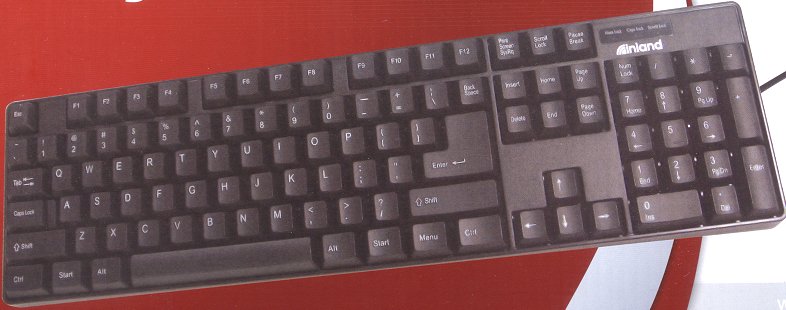
Hmm, discovered this Windows-logoless Inland Pro PS/2 Keyboard on sale for cheap recently. Our good friend Bill must have forgotten to bribe them.
Web browsers
A web browser is an application that retrieves documents over a network,
and renders them on a computer screen.
To think of a web browser as more than that is insanity. Yet people insist on continuing to try to shoehorn other technologies in to a web browser, and users pay the price in usability while vendors pay the price in maintainability.
Firefox
Firefox, is kind of losing it. But it is the only browser that is not
based on Google Chrome. I'd like to see a "classical" user interface return
(proper system box, title bar, drop down menus, etc.) PaleMoon/NewMoon/Serpent
are great alternatives, but can't keep up with ever changing web "standards".
Chrome
Not really sure why Google decided it needed it's own browser, especially
since Google has various marketing deals with Firefox. Chrome is based
on the KDE rendering engine so it is fairly speedy and slick. Apparently
it sends back some information about your browsing habits to google. I
guess that's why they wanted it.
Netscape
Back in the day Netscape 3.0 was king of the hill. They made some mistakes
but were murdered by Microsoft.
Internet Explorer
Internet Explorer is evil! EEEVIIIIIIIIIILLLLL! (Have I mentioned that?)
Microsoft Edge
It is unbelievable that Microsoft actually made a Google Chrome based
browser the default browser. How the mighty have fallen. Although they
still can't remove the rotting corps of IE due to all of its former "integration".
Windows 1.x through 3.x
Literally a graphical shell that ran on top of MS-DOS. Both the MS-DOS
Executive and Program Manager shells were primitive and unfriendly compared
to the original Macintosh Finder.
Windows 95
An impressively re-designed user interface that seemed very well thought
out, researched and tested. The Explorer shell (no relation to Internet
Explorer at this point) heavily lifted ideas from the Macintosh Finder,
but it worked the way I wanted a desktop user interface to work and did
so seamlessly with existing Windows application.
Underneath the hood Win95 still ran on top of DOS and was still based
on Windows 3.x but most of the user applications had been ported to 32-bit.
The upside was it was compatible with most DOS/Windows 3.1 applications
and utilities.
The Windows 95 OSR/2 update brought Windows 95 to near perfection by
adding FAT32 and USB capability.
Windows 98/Internet Explorer 4
*BAAAAARRRFFFFF*
All the hard work and testing done for Windows 95 UI thrown down the
drain as IE replaced the inner workings of the Window Explorer deskop.
Why? I can't think of any technical reason. They did it to crush Netscape
by forcing IE to always be installed. The few sensible UI enhancements
could have been done without IE. It made IE start faster than Netscape
because 90% of IE got loaded in to memory at startup - and made everything
else run slower And the IE 4 Channel Bar? They literally put a "this
space for rent" sign on a section of the desktop and sold advertising space
to the highest bidder. Sick.
Windows 2000/XP
MS did a good job at finally merging the stability of NT 4 with the
functionality (DirectX, FAT32, USB) of Windows 9x. Too bad about IE shell
though. And that unfortunate "bozo the clown" theme they included by default
on XP.
Windows Vista
Under the hood not much different from Windows XP (or 2000 or NT 4
or NT 3.51). Above the hood they poorly ripped off MacOS X. Copying a few
ideas would be no big deal, but they POINT BY POINT copied all of the major
features of MacOS X, and stuffed them in to Windows in ways that don't
entirely make sense. Oh, and new Digital Restrictions Management to keep
me from doing what I want with my computer and data? No thanks.
Windows 7
Microsoft rearranged the desktop again, marketed the heck out of it,
and everybody ate it up. They didn't change anything significant from Vista
that a regular person would care about. It will come bundled with all new
PCs, but there is no real reason for anyone to run out an upgrade.
Windows 8.x
Whoever thought putting a mobile UI on a desktop OS was a complete
idiot and needs to be killed. At least this time, I'm not the only one
who thinks so. The market has fairly heavily punished them. They somewhat
undid that in Windows 10, but they are not forgiven.
Windows 10
Yawn. They can't count to 10 without forgetting a number.
Windows 11
Just Make it stop. Please. Microsoft promised there would NEVER be
another version, then Apple went and bumped their version to 11.
Macintosh
These Apple Macintosh x64 is just an overly glorified IBM-PC compatible
running a modern version of NeXTStep. They are still proprietary hardware
since they won't permit MacOS X to run on anything else. Really I feel
they lost some uniqueness when they switched from PPC.
Macintosh ARM
Well, Apple moved away from Intel now. There was really no good reason
to do that. Well, now they have just turned Macs in to large iPhones. Time
to buy all new software again.
Linux
An operating system that is not tied to a specific vendor is critical
to the diversity and competitiveness of the computing industry, and Linux
delivers. A world without Linux would be like a world where IBM PC compatible
computers were still only available from IBM!
ReactOS
ReactOS is the future of Windows. What Linux did to commercial Unix,
ReactOS will do to Windows.
MAME
Most old games are more fun than the crap you can buy today. One of
my favorite oldies is OutRun.
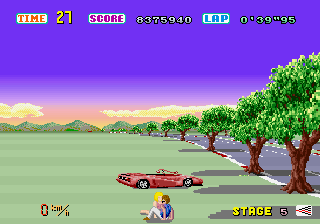
Screw the race, that guy should just make out with the hot chick.
Drive faceplate colors:
Why is it that all cases and drive face plates on CD/DVD/Floppy/Etc
drives are black these days? Back in the PC/XT days they were all black,
and then everybody switched to beige. Now black is back and you can't even
find a beige face plate any more. Of course nothing beats iOmega Blue.
:)
Religion - (ug!)
There is no such thing as "god". Sorry, about that. Idiots.
Facial Tissues
Have you ever noticed how the pictures or images on tissue boxes are
often of things that trigger allergies? Cats? Flowers? Really?
Have you ever noticed how much dust facial tissues put off? There is a conspiracy here to keep people coming back for more tissues. Watch out for the New Improved Kleenex brand: now awesomely flower scented, made with genuine ragweed fiber, and boxes made with recycled peanut shells.
Disk Vs Disc
It seems like more people are spelling the word as "disc", but it is
actually "disk" unless you are British.
Recyclers
Before throwing out old computing devices (especially 1980s or earlier),
look around to see if anyone wants them. Remember, all "recyclers" do is
melt stuff down in to neatly organized blobs of copper, aluminum, gold,
glass, etc., or send them to a Chinese landfill.
Vintage Computing - Save
the old computers!
I fully expect non-locked down, multipurpose computers to become illegal
one day. Collect them while you can.
Revolvy
You ever try searching for something and the first hit is to that content-less
spam site "Revolvy"?
Reliable Heating And Err
Or, "Nothing Runs You Over Like A Trane"! Small condo unit and need
a new AC? DO NOT go with the Trane brand. And if you happen to be in the
Atlanta area, do NOT go with "Reliable Heating and Air".
"What's a computer?", Georgia
Based on the very insulting Apple "Duh,
what's a computer?" video:
No more printed Georgia tax booklets
That's just stupid. Not everyone has a computer, and paper is infinitely
more secure than on line. Now people who don't want to use a computer have
to print their own tax booklets - from a computer!
Consumertards
Not only do modern consumers put up will all kinds of dumb crap, they
think you should too!
Packing Peanuts and paper-cushioned
USPS mailers
Packing Peanuts always make a huge, huge mess. Why do people insist
on using them? Whoever came up with the idea of finely shredded paper cushioned
USPS mailers simply needs to be shot.
The 2020 Presidential Debate
Hope everyone who watched it had an ample supply of barf bags.
Why does a Covid-19 test require a
cell phone?
Yea, why does a simple covid test work only with a smart phone with
no option to use a regular computer?
Common eBay Errors and eBay selling tips
Or how to NOT sell an item. Yes, I am more of a buyer, but these are
common mistakes that I see all the darn time when people sell on eBay Creigslist,
and forums.
2021
If 2020 was a dumpster fire, then 2021's promises of a vaccine, normality,
jobs, and a new president, it started off looking like a nice sunny Florida
beach front condo... well, that collapsed quickly.
My Site is Perfect
No seizure inducing graphics (except a few animated gifs). Best viewed
on a real computer. I don't care about your toy cell phones.
Modern Job Searching
There has got to be a better way to find employment. With all the tools
and technology we have, we just make it harder and harder to hire real
people..
What is The Cloud?
I really, really hate that term. It is too vague and people misuse
it too often.
I do not want or need a "smart" phone!
It's worse than how idiots fell in love with Internet Explorer. I fully
expect eating and breathing to soon require a smart phone. And no one will
think it is unusual, strange, or unreasonable. Because the TV says smart
phones are glorious! Actually, in some places, eating may already require
a smart phone.
Interactive Voice Response (IVR) Systems
I do NOT talk to machines unless I am YELLING at them. Yet various
support telephone numbers insist that I talk to their toaster. Here is
what is wrong with them.
LED Lights, how I hate thee.
Most LED lights hurt my eyes, and there are so many other problems
with them, it is just ridiculous.
I Hate Walmart!
This year, walmart has become much more hostile towards its customers.
If only I could afford to shop at Publix.
The 2024 Presidential
Election
Australia called. They asked "WTF Mate?"